TL;DR: Turn the bottle around. Find the serving size, read EPA and DHA separately, and compare products using the same number of capsules or liquid volume. Oil weight and total omega-3s are different numbers. Then check ingredients, allergens, storage and what any testing claim actually covers.
Start with the serving, not the front of the bottle
The front may emphasize fish oil, total omega-3s or a single fatty acid. The Supplement Facts panel supplies the serving size and the amounts for that serving. A serving could be one softgel, two softgels or a measured amount of liquid. FDA also permits a separate per-unit column, so read the column heading before doing arithmetic. The manufacturer’s serving is a label basis, not a personalized recommendation. See the FDA supplement labeling guide.
Example: two imaginary labels. These are label-reading exercises, not suggested intakes.
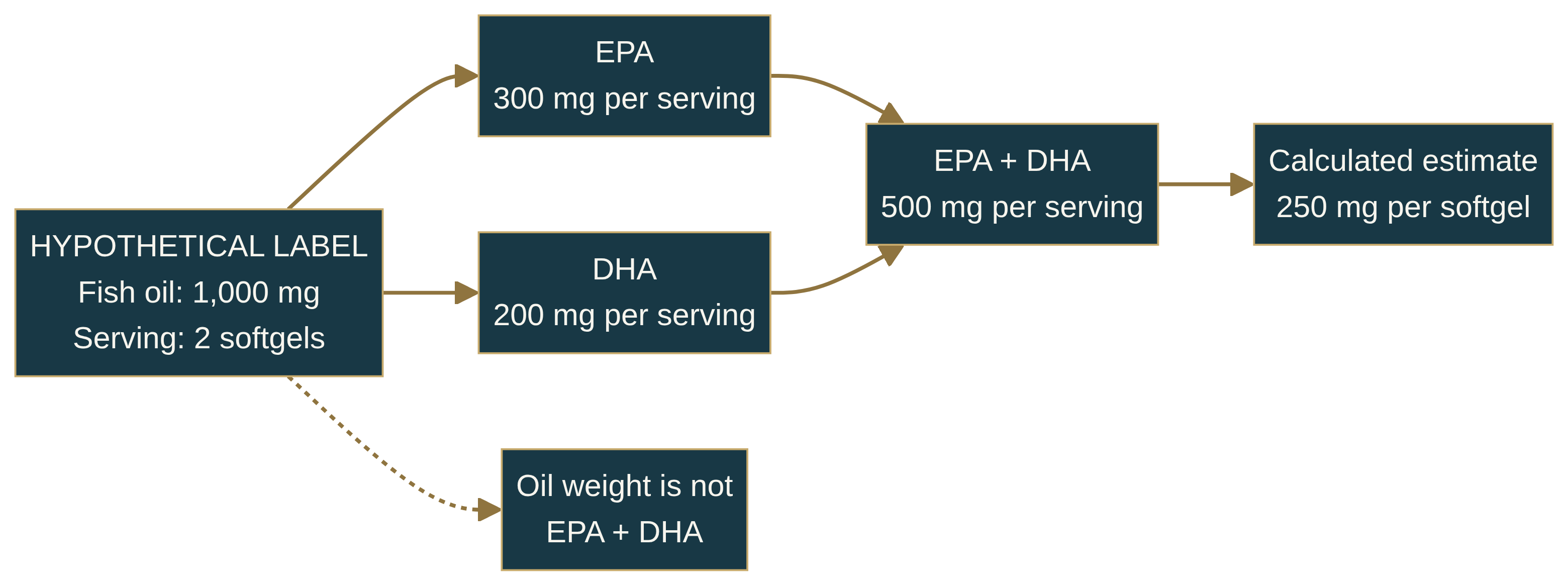
| Label detail | Product A | Product B |
|---|---|---|
| Serving | 2 softgels | 1 softgel |
| Fish oil per serving | 1,000 mg | 1,000 mg |
| EPA per serving | 300 mg | 300 mg |
| DHA per serving | 200 mg | 200 mg |
| Total omega-3s per serving | 600 mg | Not disclosed |
| EPA plus DHA per serving | 500 mg | 500 mg |
| EPA plus DHA per softgel | 250 mg | 500 mg |
Both servings list 500 mg EPA plus DHA, but Product A needs two softgels to reach that amount. In A, the extra 100 mg in the total omega-3 line represents omega-3s other than EPA and DHA. The difference between the 1,000 mg oil and the 500 mg EPA plus DHA is not all additional EPA or DHA. NIH notes that fish-oil formulas vary in their composition. NIH ODS omega-3 fact sheet
For any two products, calculate EPA + DHA per serving, then divide by the number of softgels in that serving if you want a per-softgel comparison. For liquids, divide the stated amount by the serving volume in milliliters to compare per mL. Convert units first: 1 gram equals 1,000 milligrams. Rounding on labels means calculated per-unit amounts are estimates.
Know which omega-3 number you are reading
EPA and DHA are distinct fatty acids; the label may list both, only one, or only a combined total. Add the separate amounts only when they refer to the same serving and ingredient. EPA plus DHA is not necessarily the same as total omega-3s, which can include other omega-3 fatty acids. If either amount is missing, record it as not disclosed, not zero, and ask the manufacturer for the breakdown of that exact formula.
Another omega-3, ALA, is common in flaxseed oil. It is not EPA or DHA, and the body converts only small amounts of ALA into those fats. Algal oils supply DHA and some also supply EPA; the source name alone does not identify the amount of each. NIH ODS and NIH NCCIH explain the different sources. For more on the components, see EPA vs DHA basics.
An asterisk beside “Daily Value not established” means there is no established Daily Value for that ingredient; it is not a safety or usefulness rating. Do not treat a ratio or a larger number alone as proof of a better health outcome. FDA labeling guide
Look beyond Supplement Facts
Read Other Ingredients for the capsule material, flavorings, sweeteners and other additions. Check the oil source and any allergen statement. In the United States, FDA’s major-allergen labeling rules generally apply to dietary supplements, but advisory statements about possible cross-contact are not mandatory. If you have a fish or shellfish allergy, ask the manufacturer about the exact product and cross-contact, and discuss suitability with your clinician; the absence of a “may contain” statement is not a guarantee. FDA food allergy guidance
Fish liver oils may also supply vitamins A and D, in amounts that vary by product; too much of either can be harmful. Include those amounts when considering other supplements. For a child, check the age range, serving and full label with a pediatric clinician. If you take warfarin or another anticoagulant, ask a clinician or pharmacist about possible interactions before adding an omega-3 supplement. NCCIH and NIH ODS
Decode process claims and testing seals
“Molecularly distilled” describes a processing step. For example, Nordic Naturals describes its use of vacuum distillation to help remove impurities. That process name alone is not a measurement of every contaminant in a finished bottle and does not establish effectiveness. See molecular distillation on labels for questions to ask.
For a third-party seal or certificate of analysis, check who tested what, when, against which limits and for which lot. A test of raw oil is not automatically a test of the finished product. A seal for one type of check does not demonstrate every quality attribute or a clinical benefit. FDA regulates supplements but does not approve them for safety and effectiveness before marketing. FDA supplement Q&A
Treat “clinically studied” or similar health claims as questions, not conclusions. Does the evidence concern the same formulation and amount, and the same outcome and group of people? The FTC’s health-products guidance explains why research must be relevant to the specific claim. Prescription omega-3 medicines are not interchangeable with ordinary supplements simply because both mention omega-3s. NCCIH
Read storage instructions and finish your comparison
Check the date, seal and instructions for storage before and after opening. A laboratory report reflects the sample and time tested; it cannot establish how your opened bottle was stored. In a published storage study, oxidation measures changed differently across the specific products tested, and flavorings interfered with one common test. Do not use smell, taste or a freezer test as proof of freshness. If the seal is damaged or the contents seem spoiled, stop using the product and contact the manufacturer. See how to store fish oil for more detail.
Before choosing, write down the exact formula, serving, EPA and DHA amounts, source, relevant ingredients, number of servings, storage instructions and what is unknown. Compare the same basis, then check the current package: formulas and labels can change. Start with fish oil softgels, algae oils or the comparison tool; verify product details on the current manufacturer label rather than assuming a directory is current.
Sources
- FDA: Dietary Supplement Labeling Guide, nutrition labeling
- FDA: Questions and Answers on Dietary Supplements
- FDA: Food Allergies
- NIH ODS: Omega-3 Fatty Acids, consumer fact sheet
- NIH NCCIH: Omega-3 Supplements: What You Need To Know
- FTC: Health Products Compliance Guidance
- Nordic Naturals: Fish Oil Manufacturing Process
- Food Science & Nutrition: Effect of packaging and encapsulation on oxidative and sensory stability of omega-3 supplements
Frequently asked questions
Is 1,000 mg of fish oil the same as 1,000 mg of EPA and DHA?
No. Fish oil contains other fats. Look for the separately listed EPA and DHA amounts on the same serving basis.
Can I add EPA and DHA to get total omega-3s?
You can add them to get EPA plus DHA, but total omega-3s may also include other omega-3 fatty acids.
What if a label lists total omega-3s but not EPA and DHA?
Do not assume the missing amounts are zero or divide the total between them. Ask the manufacturer for the exact product's breakdown.
What does Daily Value not established mean?
It means there is no established Daily Value for that labeled ingredient. It does not mean the ingredient is unnecessary or that any amount is appropriate.
Does an algae oil always contain both EPA and DHA?
No. Algal oils can provide DHA, and some also contain EPA. Check the specific formula and its full ingredient list.
Does a testing seal prove a supplement will work for me?
No. A seal applies only to its stated program and tests. It is not proof of a clinical benefit or suitability for a particular person.
Should a child's serving match the amount on the package?
A label direction is not individualized medical advice. Check the age range and discuss the product, other supplements, diet and medicines with a pediatric clinician.